
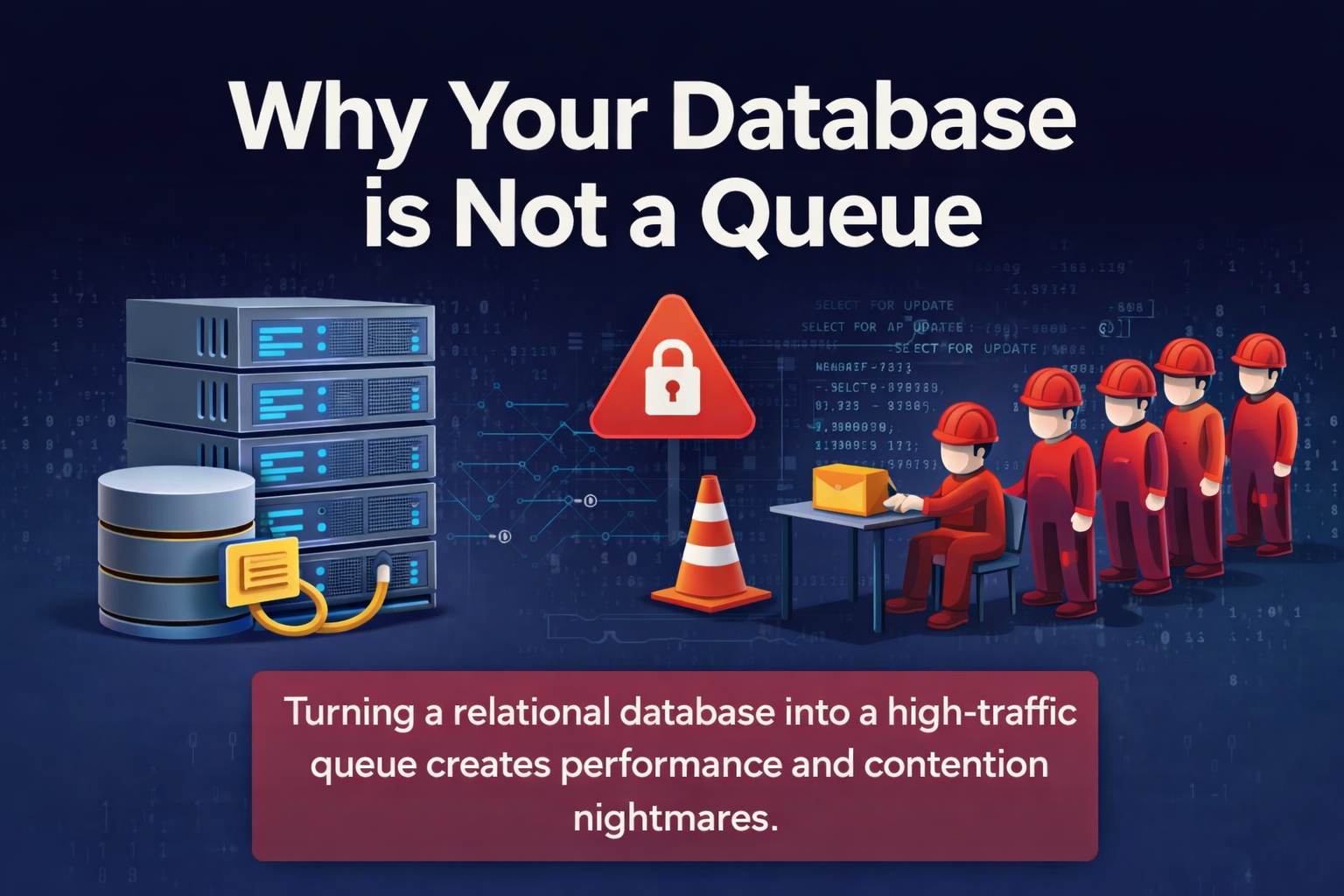
The hidden cost of the easy choice.
Almost every Laravel developer makes the same decision at the beginning.
You need to send a welcome email, process an export, resize an image, or dispatch a notification. You open .env, set QUEUE_CONNECTION=database, run the migration, and move on. It is simple, built in, and works perfectly on a local machine.
That convenience is exactly why it becomes dangerous later.
At a small scale, the database queue driver feels harmless. At a larger scale, it turns your primary data store into a transport layer for temporary background work. Instead of focusing on the real job of storing and serving application data, your database starts spending time on low-value churn: insert, lock, poll, update, delete, repeat.
That is not what your main database is good at.
Databases are built for persistence, not queue churn.
Relational databases like MySQL and PostgreSQL are excellent at durable storage, indexing, joins, transactions, and consistent reads. They are not designed to be the fastest possible engine for an endless stream of short-lived background jobs.
A queue has a very specific access pattern:
- write a job
- reserve it
- lock it
- process it
- delete or mark it failed
When Laravel uses the database queue driver, workers constantly compete over the same jobs table. To prevent multiple workers from taking the same job, the system relies on row locking mechanisms such as SELECT ... FOR UPDATE or equivalent reservation strategies.
This is where the problem begins.
As traffic grows, queue workers create contention around a shared table. That contention does not stay isolated. It starts affecting the rest of your application because the same database server is also responsible for user-facing queries, authentication, dashboards, reports, search filters, and admin operations.
Now your app is not slowing down because of customers. It is slowing down because your background workers are fighting each other.
The bottleneck nobody notices at first.
The dangerous part is that this failure mode is gradual.
At first, everything still works. Jobs get processed. Pages still load. Nothing looks obviously broken.
Then small symptoms begin:
- background jobs start lagging
- workers spend more time polling
- lock waits increase
- failed jobs become more frequent
- CPU and disk activity rise
- application queries become less predictable
Eventually, the queue table becomes a hotspot. Instead of acting like a neutral transport mechanism, it becomes a shared bottleneck between your product and your infrastructure.
This is one of those architectural problems that hides behind short-term convenience.
Why Redis changes the game.
Redis is a much better fit for queue workloads because it is designed for high-speed, in-memory operations.
It is not just a cache. It is a data structure store optimized for extremely fast reads and writes, with very low latency and minimal locking overhead compared to a relational database queue table.
That matters because queues are not about long-term storage. They are about moving work from one part of the system to another as quickly and reliably as possible.
Redis handles this pattern well because:
- operations happen in memory
- latency is dramatically lower
- queue reservation is more efficient
- workers do not fight over a relational table
- your primary database stays focused on application data
In practice, this means your app becomes more stable under load, your jobs are processed faster, and your infrastructure scales more predictably.
The real architectural rule.
Your database should store state.
Your queue should move work.
Those are different responsibilities, and mixing them too long usually creates pain later.
Using the database driver is acceptable for local development, prototypes, tiny internal tools, or early MVPs with minimal concurrency. But once your product has real usage, email flows, imports, webhooks, notifications, image processing, analytics, or scheduled jobs, the queue deserves infrastructure that is actually built for queuing.
Laravel Horizon is not optional if you care about visibility.
Once you move to Redis, Laravel Horizon becomes one of the most valuable tools in your stack.
Horizon gives you a real operational view of your queues:
- throughput
- wait times
- worker activity
- failed jobs
- retry patterns
- queue balance across environments
Without that visibility, queues become a black box. Jobs fail silently, retries pile up, and problems are discovered only after users complain.
With Horizon, you stop guessing.
You can see what is happening, identify bottlenecks early, and treat background processing like a first-class part of your system instead of an afterthought.
When the database queue is still acceptable.
To be fair, the database driver is not evil. It is just limited.
It is perfectly fine when:
- you are building locally
- traffic is tiny
- jobs are rare
- reliability demands are low
- you want zero extra infrastructure
But it should be seen as a stepping stone, not a destination.
The mistake is not starting with the database queue. The mistake is staying there after your workload outgrows it.
Final thought.
The database queue driver feels cheap because it avoids infrastructure decisions.
In reality, it often postpones them until the moment they become painful.
If your Laravel app is doing real background work, move your queue to Redis before the bottleneck starts affecting the rest of the product. Your database will breathe easier, your workers will move faster, and your future self will spend less time debugging performance issues that never should have existed.
Soft CTA.
Want to spend less time rebuilding common product infrastructure from scratch?
Create a professional page with booking flows, scheduling, and a cleaner client experience using Meetfolio.