
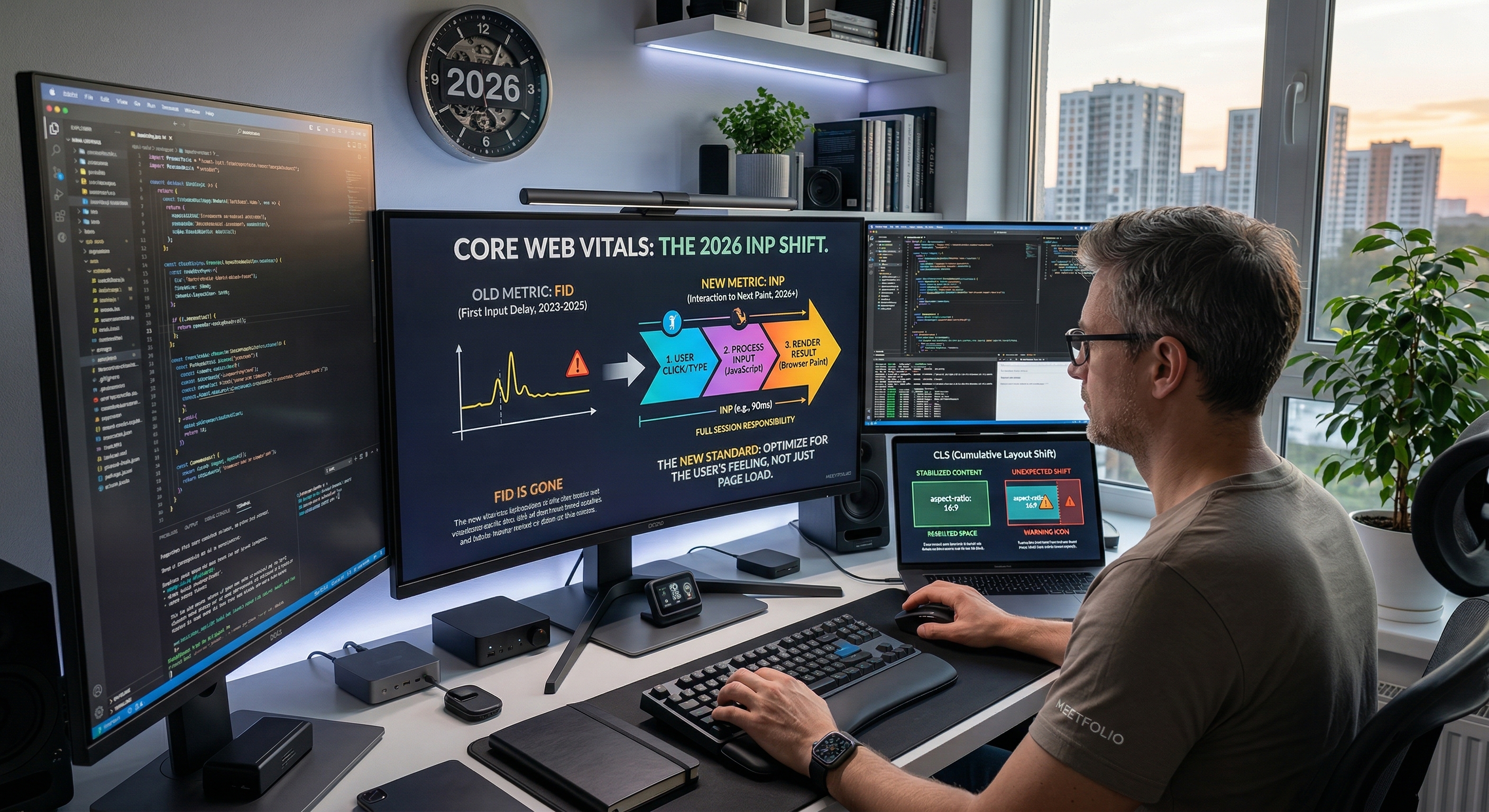
FID is gone. The browser cares about the whole experience now.
For years, front-end teams focused heavily on First Input Delay.
The logic was simple: if the user's first interaction is fast, the page feels responsive.
That mental model is no longer enough.
Modern user experience is not defined by one click. It is defined by the full session: opening menus, typing in forms, filtering lists, switching tabs, closing modals, dragging items, and triggering expensive state updates. A site can feel quick on the first tap and still feel terrible thirty seconds later.
That is why the conversation has shifted to Interaction to Next Paint, or INP.
What INP actually measures.
INP is a better reflection of how a real interface behaves in the wild.
Instead of looking only at the first interaction, it evaluates responsiveness across the full visit and pays attention to the slowest interactions that matter. It is much closer to what users actually feel.
This changes the optimization mindset completely.
You can no longer celebrate because the landing page loaded fast while ignoring the fact that your filter drawer freezes, your dashboard stutters, or your React form locks the main thread during validation.
INP forces teams to optimize the actual product, not just the page load screenshot.
Why frozen UIs destroy trust fast.
A user does not think in milliseconds. A user thinks in confidence.
The moment they click something and nothing visually happens, even for a short time, the interface starts to feel broken. That feeling is expensive. It creates hesitation, repeated clicks, abandoned tasks, and a subtle loss of trust in the product.
In modern front-end apps, slow interaction usually comes from one place: the main thread being overloaded.
That happens when:
- JavaScript work is too heavy
- state updates trigger too much rendering
- large payloads are parsed at the wrong time
- expensive components mount during interaction
- layout and paint costs spike after DOM changes
A site does not need to crash to feel bad. It only needs to miss the moment when the user expects feedback.
INP is a product architecture problem, not just a Lighthouse problem.
Many teams still treat performance as an audit checkbox.
That approach does not survive INP.
INP punishes architecture choices that make interfaces fragile:
- huge client-side bundles
- over-rendered component trees
- synchronous work inside input handlers
- blocking parsing on interaction
- slow hydration paths
- poorly timed network-dependent UI updates
This is why performance work in 2026 is less about tiny micro-optimizations and more about system design. Split work. Defer non-critical logic. Avoid expensive synchronous paths. Keep interactions lightweight.
If a click causes too much work, the browser cannot paint in time.
That is the whole game.
CLS is still quietly ruining polished interfaces.
While teams focus on responsiveness, Cumulative Layout Shift still destroys perceived quality in quieter ways.
Users hate moving targets.
If buttons jump, text shifts, cards resize, skeletons collapse, or images load without reserved dimensions, the product feels sloppy even if it is technically fast.
One of the simplest and most effective protections is still reserving space before content arrives:
- use width and height on media where possible
- use
aspect-ratio - avoid injecting content above existing content
- stabilize dynamic banners and embeds
- design skeletons to match final layout
CLS is not just a metrics issue. It is a respect issue. It tells the user whether your interface is under control.
The new trick: perceived instant navigation.
One of the most interesting modern performance strategies is reducing the gap between intention and response.
If the browser can predict where the user is likely to go next, it can begin preparing that experience in advance. That is where things like the Speculation Rules API become so powerful.
When used carefully, predictive prefetching and prerendering can make navigation feel almost immediate. The product starts behaving less like a website waiting on the network and more like a local application.
That kind of speed is not just technical polish. It changes how premium your product feels.
What high-performing teams do differently.
Teams that perform well against modern web vitals usually share the same habits:
- they measure real interactions, not only lab scores
- they profile heavy UI flows, not just page load
- they treat responsiveness as a feature
- they design components to fail gracefully under load
- they challenge every synchronous block on the main thread
The difference is not that they care more about Lighthouse. The difference is that they care more about what the user actually experiences.
Final thought.
The move from FID to INP is bigger than a metrics update.
It is a shift in what "fast" really means.
A fast site is no longer one that only loads quickly. A fast site is one that keeps responding smoothly after the user starts interacting with it.
That is a much higher standard.
And honestly, it is the right one.
Soft CTA.
If your product needs to feel professional, speed is not optional. Neither is a smooth booking and presentation flow.
Build a cleaner client-facing experience with Meetfolio.